
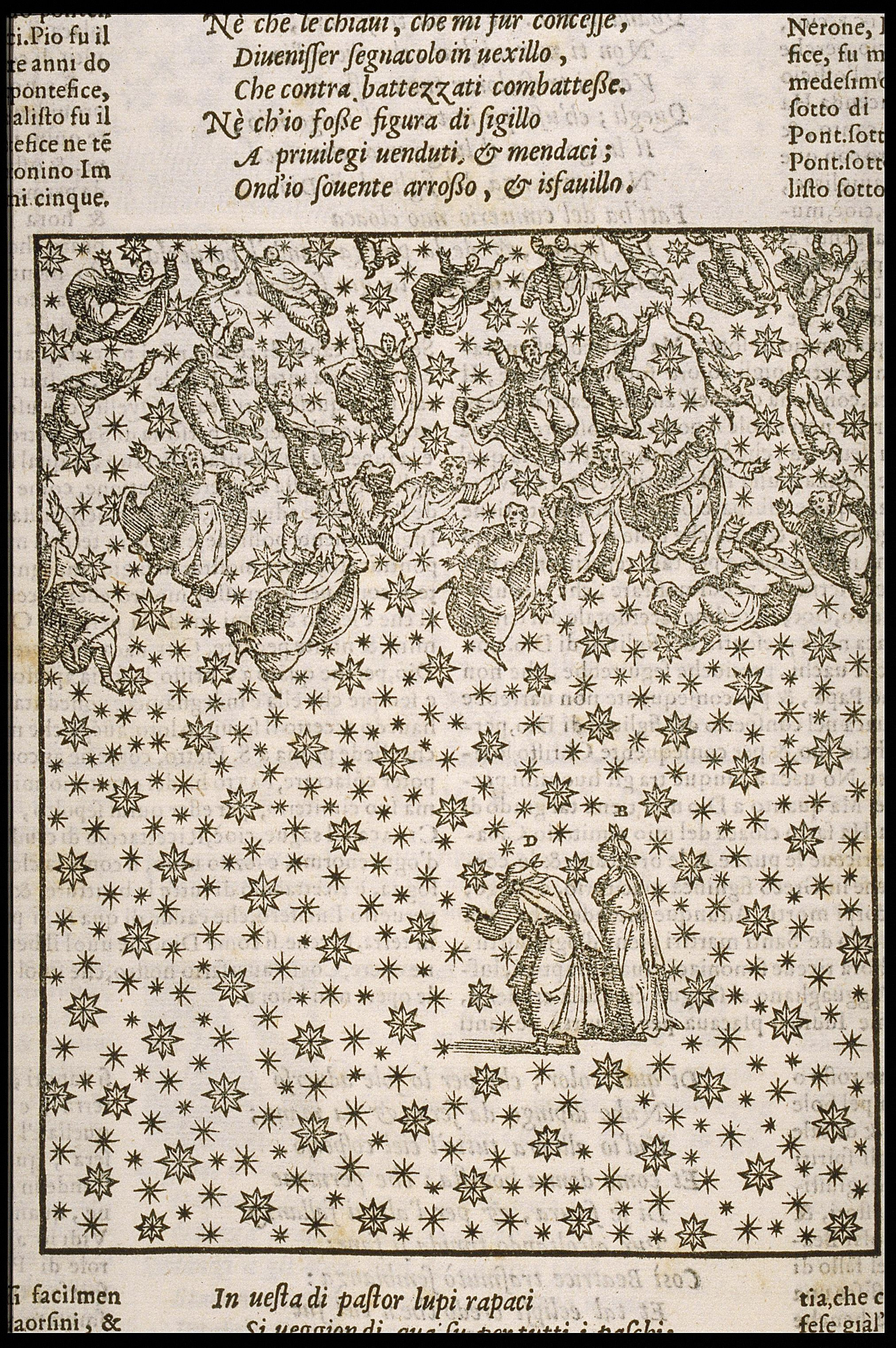
 Unknown Artist
The Divine Comedy by Dante Alighieri, was written in the early 14th century; it tells the story of a symbolic journey through Hell, Purgatory, and Paradise, tracing the soul’s ascent toward God. The poem was crucial in shaping the Tuscan dialect as the foundation of modern Italian and in merging theology, philosophy, and poetic imagination into a grand vision of the moral and spiritual order of the universe. Its influence has endured for centuries, inspiring countless writers, artists, and thinkers, and shaping how Western culture envisions the afterlife.
The woodcut we share today illustrates a moment from Paradiso, Canto XXVII, known as The Sphere of the Fixed Stars. In this scene, Dante, guided by Beatrice — the woman he loved and idealized, who in the poem represents divine wisdom and spiritual love — looks upon the vast heavens filled with constellations, including Gemini, the sign under which he was born. As he contemplates the stars, Dante reflects on the divine order of creation and the source of his own intellect and inspiration. The image captures his awe before the cosmos and the moment of spiritual enlightenment that prepares him to ascend to the Primum Mobile, the highest sphere of heaven and the threshold of God’s presence.
Beautiful, isn't it?
P.S. Inspired by Dante’s masterpiece? Explore the world that shaped it in our Art of the Renaissance Florence digital course. Learn how the great artists and thinkers of the Italian Renaissance brought ideas like these to life!
P.P.S. The Divine Comedy has inspired numerous artists throughout the centuries. Do you know who painted one of the most famous academic depictions of Dante's Hell?